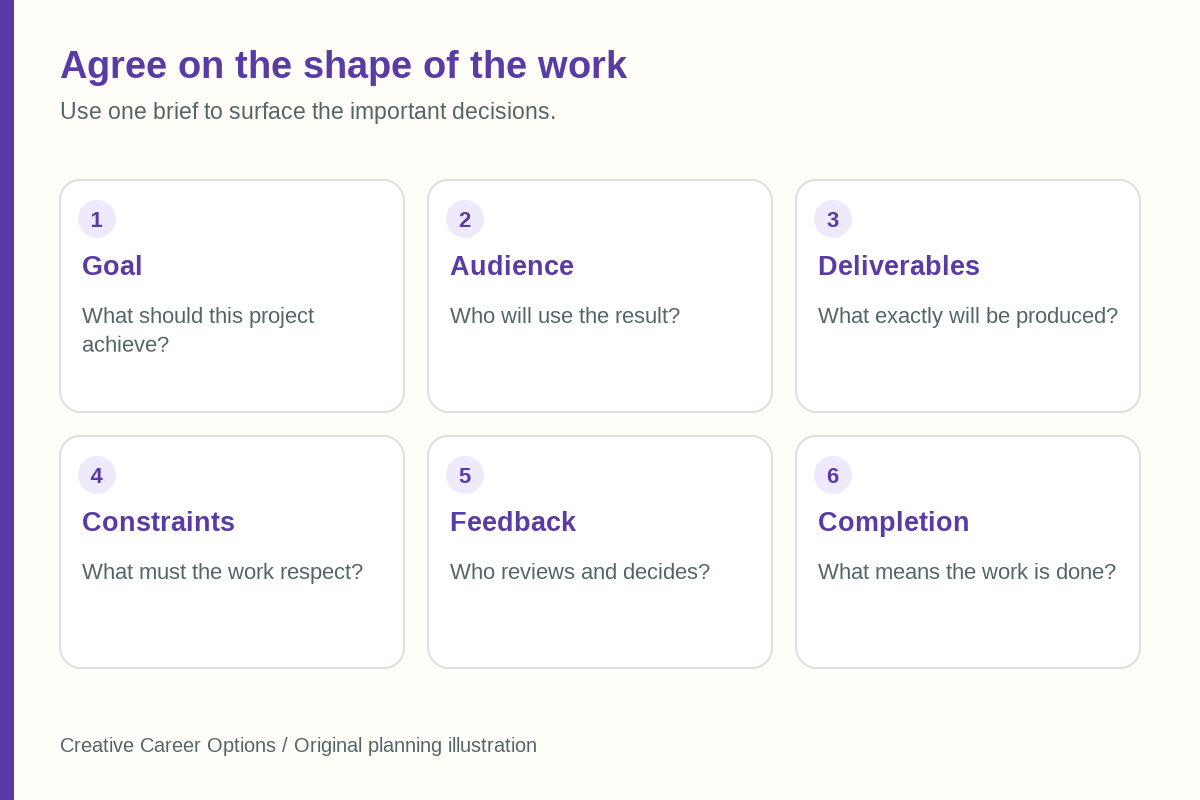
Define the job in ordinary language
A brief is a shared description of the work. Start with the intended audience and what the finished material needs to help them do. “Make it modern” is a preference; “help visitors compare three service options on a phone” describes a task. Both can belong in a brief, but they serve different purposes.
Name one person who can resolve conflicting feedback. A project with several contributors can still have a clear decision route. Record assumptions that have not been confirmed so they are visible before they turn into rework.
List deliverables separately from activities
“Explore three directions” is an activity. “Supply one approved poster as a print-ready file and a social image” describes outputs. Write the files, formats, sizes, variants and intended uses that matter for this particular project. Avoid adding technical requirements that nobody needs.
Add a short out-of-scope list. It can be as simple as “copy translation is not included in this brief” or “photography is supplied by the client.” This worksheet is an operational planning aid; it does not replace a contract or determine legal rights.
Plan the feedback moments
- Before production: agree on the goal, audience and required material.
- At a useful intermediate stage: test direction while changes are still manageable.
- Before delivery: check the approved content and required files.
- At handover: confirm where the files live and who maintains them.
Keep changes visible
When a request changes, write down what is new, what it affects and who will decide the next step. A change log prevents a later conversation from depending on memory. Do not silently treat a new deliverable as a small wording correction.
For a fictional event-poster project, changing an event date is a content correction. Adding a second language and six venue-specific versions is a scope decision. The useful response is to update the brief, timing and review needs, then agree how to proceed.
Finish by reading the brief as the person doing the work. If a missing file, unknown decision-maker or unclear success criterion would stop you tomorrow, resolve it or mark it as an explicit dependency today.
One-page project brief
| Field | Prompt | Your decision |
|---|---|---|
| Purpose | Who needs to do what? | |
| Outputs | Which files, sizes and variants? | |
| Inputs | Who provides copy, assets and approvals? | |
| Review | Who decides, and at which stages? | |
| Dependencies | What is missing or unconfirmed? | |
| Change log | What changed, when and with what impact? |
Put the plan to work
Use your own information to make a practical next step.
Open the planning worksheetSources and review
This guide is an original planning resource. Its worksheets and examples are organizational aids, not a report of product testing or verified customer results.
An original organizational worksheet and workflow. Examples are illustrative, not reports of customer results.
How these guides are prepared